Day after day,
Alone on the hill,
The man with the foolish grin is keeping perfectly still,
But nobody wants to know him,
They can see that he's just a fool,
And he never gives an answer,
But the fool on the hill
Sees the sun going down,
And the eyes in his head,
See the world spinning 'round.
Alone on the hill,
The man with the foolish grin is keeping perfectly still,
But nobody wants to know him,
They can see that he's just a fool,
And he never gives an answer,
But the fool on the hill
Sees the sun going down,
And the eyes in his head,
See the world spinning 'round.
The reply to juggler's comment in the previous post got me thinking more about detachment. A few years ago, I had an incredible urge to renounce the world, go off to the hills and live as an ascetic. But circumstances changed and things had to be done. Anyhow, I started work here, but was confused at times between "making money" and "self discovery". The fool on the hill is perfectly happy, and I would have been too, following a path of introspection and self discovery. Making enough to survive is really not that difficult.
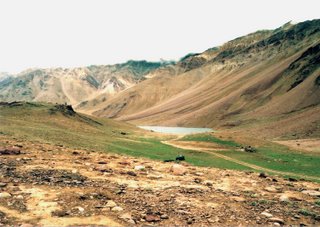 On my recent trip to Spiti Valley in the Himalayas, I went to Kibber, a village which (somewhat dubiously according to the Lonely Planet) claims to be the highest village in the world. (The photo by the way is not Kibber, but Chandratal in Spiti). I met a Kibberite there and asked him how many people stayed in the village to which he quickly replied '420'. After a moments thought, he apologised and corrected himself saying there were only 418 people in the village. He said he had a family of four and around 1 1/2 acres of land where he farms peas mainly. (An acre of land there costs about Rs. 30,000/- he said). From that, he earns enough money to feed his family, pay all the bills and send his kids to school. He works for only around 4 months in a year during summer. I'm not saying that by having nothing you can be happy, I don't know whether he was happy.
Anyway, making enough to survive, I could have lived happily in contemplation. Since people who have "everything" are sometimes not happy, and sometimes people who have very little or nothing are happy, you can easily infer that happiness must be from within. Even in day to day life, things which make us feel happy or elated at a particular time might fail to do so the next time. So establishing that happiness is from within, then all we need are our physical needs.
So why does a person, who can easily have everything he needs to be happy, go out into the world? Why do we complicate our lives with all these things? Whatever the root cause was, we are now in a "material" world. It is impractical (and indeed impossible) to tell everyone to give up everything and "run to the hills".
This was obviously a dilemma faced by many people over many ages. The answer lies in Karma Yoga, the yoga of work. It basically says that to be an ascetic is relatively easy. It has its place in society, some people, at stages in their lives need to turn to that. But the most difficult yoga to practice is karma yoga. To live in the world, and yet live above it, not get dirty from it, to float like a lotus which grows in a muddy pond. It is pointless to say that we will live in the world and not use a computer or a tv, but one should see them only as tools, and not get attached to it. One can use all the luxuries in the world, but should be as happy if they are taken away the next second.
Krishna expounded the theory to Arjuna in the Mahabaratha. Arjuna was confused as to why he should engage in battle against his cousins. Krishna explains that one must do what one is called for. I believe this also to mean that one person should do what he has the skills to do. Arjuna had skills to be a great warrior, and he had a duty to his citizens to defend them. The Law of Karma, in my understanding, is exactly analoguous to Newton's Third law of motion; "Every action has an equal and opposite reaction". The Law of Karma states also includes a desire as an action. A desire sets the wheel of Karma turning and it goes on, through several lives if needed, till it meets an opposite reaction or fullfilment of the desire. Krishna advices Arjuna to disassociate himself and his efforts from the results of the action, thereby acting only out of compassion for his fellow beings, and not from any desire for a particular result. The end result is God-given and one has no control over it. This teaches acceptance.
People have a misconception that Karma is just an excuse to make up for failure and that people use bad Karma from past lives to explain if bad things happen to them. I however feel that rather than being an escapist's approach, Karma Yoga teaches you to not get stuck in the past, to learn from your experiences and move on, without brooding over spilt milk. This prepares one to confidently handle any adversity.
After looking after the entire operations of the company I feel that any businessman has a responsibility to society. He is creating employment and generating wealth, as well as paying taxes for the development of the country, and looking after the welfare of his employees. I slowly understood the social responsibility of running a business. Further, competition has a role too, in ensuring that consumers get the most out of their money. I found I could reconcile my beliefs with my actions and felt much happier. I feel that if a person has a "skills" as a manager, then one should utlise it to serve society and help his fellow man. I'm not saying everone should start a charity, but do what they're best at, and be true to themselves.
I try to detach myself from the results of my actions by not feeling elated with "successes" or sad with "failures". Everything has taught me something, and in the long run there are no successes and failures, just experiences. I still obviously have a long way to go, perhaps several lifetimes, but its not just about the destination, and I enjoy the journey as well.
(Disclaimer: I'm not some kind of hardcore Yogi or anything, I have intellectual conviction and am working, sometimes haphazardly, towards being what I believe)
 On my recent trip to Spiti Valley in the Himalayas, I went to Kibber, a village which (somewhat dubiously according to the Lonely Planet) claims to be the highest village in the world. (The photo by the way is not Kibber, but Chandratal in Spiti). I met a Kibberite there and asked him how many people stayed in the village to which he quickly replied '420'. After a moments thought, he apologised and corrected himself saying there were only 418 people in the village. He said he had a family of four and around 1 1/2 acres of land where he farms peas mainly. (An acre of land there costs about Rs. 30,000/- he said). From that, he earns enough money to feed his family, pay all the bills and send his kids to school. He works for only around 4 months in a year during summer. I'm not saying that by having nothing you can be happy, I don't know whether he was happy.
Anyway, making enough to survive, I could have lived happily in contemplation. Since people who have "everything" are sometimes not happy, and sometimes people who have very little or nothing are happy, you can easily infer that happiness must be from within. Even in day to day life, things which make us feel happy or elated at a particular time might fail to do so the next time. So establishing that happiness is from within, then all we need are our physical needs.
So why does a person, who can easily have everything he needs to be happy, go out into the world? Why do we complicate our lives with all these things? Whatever the root cause was, we are now in a "material" world. It is impractical (and indeed impossible) to tell everyone to give up everything and "run to the hills".
This was obviously a dilemma faced by many people over many ages. The answer lies in Karma Yoga, the yoga of work. It basically says that to be an ascetic is relatively easy. It has its place in society, some people, at stages in their lives need to turn to that. But the most difficult yoga to practice is karma yoga. To live in the world, and yet live above it, not get dirty from it, to float like a lotus which grows in a muddy pond. It is pointless to say that we will live in the world and not use a computer or a tv, but one should see them only as tools, and not get attached to it. One can use all the luxuries in the world, but should be as happy if they are taken away the next second.
Krishna expounded the theory to Arjuna in the Mahabaratha. Arjuna was confused as to why he should engage in battle against his cousins. Krishna explains that one must do what one is called for. I believe this also to mean that one person should do what he has the skills to do. Arjuna had skills to be a great warrior, and he had a duty to his citizens to defend them. The Law of Karma, in my understanding, is exactly analoguous to Newton's Third law of motion; "Every action has an equal and opposite reaction". The Law of Karma states also includes a desire as an action. A desire sets the wheel of Karma turning and it goes on, through several lives if needed, till it meets an opposite reaction or fullfilment of the desire. Krishna advices Arjuna to disassociate himself and his efforts from the results of the action, thereby acting only out of compassion for his fellow beings, and not from any desire for a particular result. The end result is God-given and one has no control over it. This teaches acceptance.
People have a misconception that Karma is just an excuse to make up for failure and that people use bad Karma from past lives to explain if bad things happen to them. I however feel that rather than being an escapist's approach, Karma Yoga teaches you to not get stuck in the past, to learn from your experiences and move on, without brooding over spilt milk. This prepares one to confidently handle any adversity.
After looking after the entire operations of the company I feel that any businessman has a responsibility to society. He is creating employment and generating wealth, as well as paying taxes for the development of the country, and looking after the welfare of his employees. I slowly understood the social responsibility of running a business. Further, competition has a role too, in ensuring that consumers get the most out of their money. I found I could reconcile my beliefs with my actions and felt much happier. I feel that if a person has a "skills" as a manager, then one should utlise it to serve society and help his fellow man. I'm not saying everone should start a charity, but do what they're best at, and be true to themselves.
I try to detach myself from the results of my actions by not feeling elated with "successes" or sad with "failures". Everything has taught me something, and in the long run there are no successes and failures, just experiences. I still obviously have a long way to go, perhaps several lifetimes, but its not just about the destination, and I enjoy the journey as well.
(Disclaimer: I'm not some kind of hardcore Yogi or anything, I have intellectual conviction and am working, sometimes haphazardly, towards being what I believe)


